
Special Photo Exhibition Revisits India’s Role in the Korean War
- MGMMTeam

- Apr 21
- 3 min read
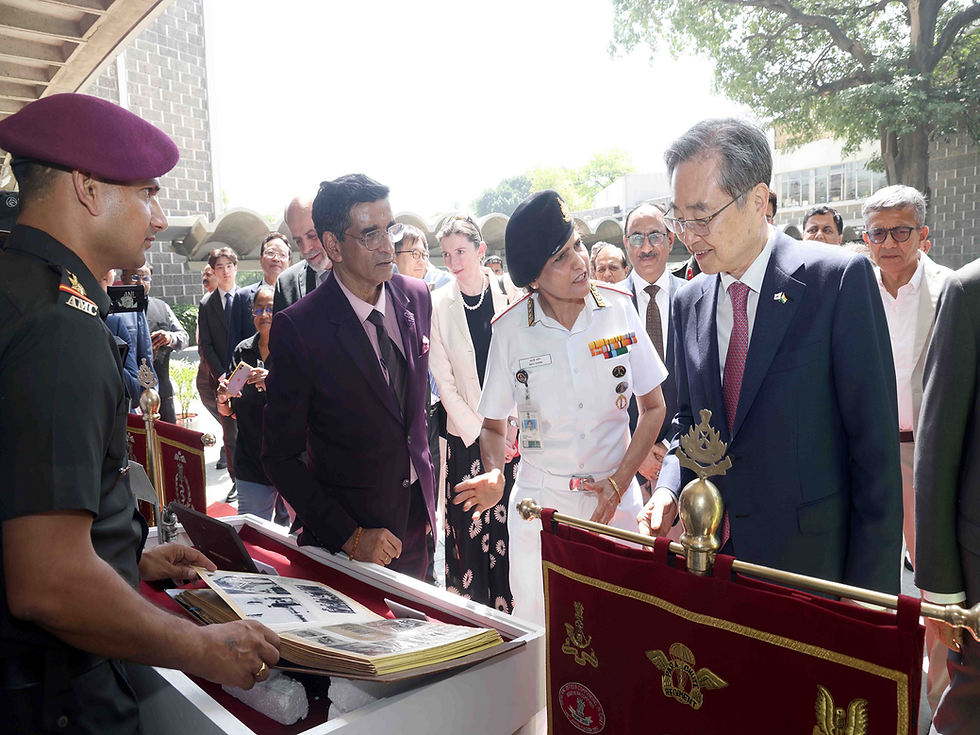
A special photo exhibition in New Delhi has brought renewed focus to India’s significant yet often underappreciated role during the Korean War. Organised at the India International Centre, the exhibition presents a compelling visual archive of India’s diplomatic, humanitarian, and peacekeeping efforts during a defining moment of the Cold War. Through rare photographs and historical records, it highlights how India contributed meaningfully without direct military engagement.
A Policy of Neutrality and Strategic Diplomacy
At the onset of the conflict, India, under the leadership of Jawaharlal Nehru, chose a path of non-alignment rather than military participation. This approach enabled India to act as a bridge between opposing global blocs, including the United States, the Soviet Union, and China. By maintaining neutrality, India played a constructive diplomatic role, advocating dialogue and peaceful resolution at international forums such as the United Nations.
India’s diplomatic efforts were particularly evident in its proposal to resolve the issue of prisoners of war, which had become one of the most contentious aspects of the conflict. This initiative eventually gained acceptance and contributed to easing tensions between the warring sides, reinforcing India’s reputation as a responsible and balanced global actor.
Leadership in the Neutral Nations Repatriation Commission
One of India’s most notable contributions came after the armistice, when it chaired the Neutral Nations Repatriation Commission. This body was tasked with overseeing the safe and voluntary return of prisoners of war. The commission was led by K. S. Thimayya, whose leadership was instrumental in managing this complex and sensitive operation.
India also deployed the Custodian Force India, a dedicated military unit responsible for implementing the commission’s mandate on the ground. This mission required not only logistical precision but also diplomatic sensitivity, as it involved navigating the competing interests of rival powers while ensuring humane treatment of prisoners.
Humanitarian Contributions on the Ground
In addition to its diplomatic initiatives, India made vital humanitarian contributions during the war. The 60th Parachute Field Ambulance unit of the Indian Army was deployed to provide medical assistance to wounded soldiers and civilians. Operating in challenging conditions, the unit treated a vast number of patients and earned international recognition for its dedication and professionalism.
These efforts reflected India’s broader commitment to humanitarian values, demonstrating that meaningful contributions to global conflicts need not always come through combat but through service and care.
Lasting Legacy and Strengthened Bilateral Relations
India’s role in the Korean War has had a lasting impact on its international identity as a nation committed to peacekeeping and diplomacy. The experience strengthened its credentials in global conflict resolution and laid the groundwork for future contributions to United Nations peacekeeping missions.
Over the decades, this shared history has also contributed to the development of strong bilateral ties between India and South Korea. Today, the relationship spans economic cooperation, strategic partnerships, and cultural exchanges, rooted in a foundation of mutual respect and historical goodwill.
The MGMM Outlook
The exhibition at the India International Centre brings overdue attention to a chapter of history where India demonstrated strategic maturity beyond conventional power politics. During the Korean War, India’s decision under Jawaharlal Nehru to remain non-aligned was not a passive stance but an active diplomatic choice that positioned the country as a credible mediator. By engaging through platforms like the United Nations and proposing workable solutions such as the prisoner-of-war resolution, India carved out a role that balanced moral responsibility with geopolitical pragmatism, showcasing how influence can be exercised without direct military involvement.
Equally significant was India’s execution of responsibilities on the ground, particularly through its leadership in the Neutral Nations Repatriation Commission under K. S. Thimayya and the deployment of the Custodian Force India. Alongside this, humanitarian efforts like those of the 60th Parachute Field Ambulance underscored a commitment to human dignity even amid conflict. These combined actions not only strengthened India’s global standing as a peace-oriented nation but also laid a durable foundation for its evolving relationship with South Korea, proving that diplomacy backed by humane action can leave a deeper and more lasting impact than force alone.
(Sources: News On Air, ANI News, Tribune India)


Comments