
PM Modi Slams Opposition for Spreading Panic Amid Iran War, Highlights Farmer Welfare and ₹14,000 Crore Development Push in Gujarat

Prime Minister Narendra Modi on October 30 criticised Opposition parties for allegedly spreading misinformation and creating unnecessary panic among citizens amid the ongoing Iran war. Addressing a public gathering in Bhildi, Banaskantha district of Gujarat, he said that while the country was dealing with international uncertainties, certain political groups were attempting to create fear through rumours about essential commodities.
Without naming any political party, PM Modi questioned the intentions of those allegedly spreading misleading information about fertiliser and cooking gas availability. He said that farmers were being frightened with claims of fertiliser shortages, while women were being made anxious by rumours about LPG supplies. The Prime Minister emphasised that India was taking necessary steps to manage the international situation and protect the interests of ordinary citizens. He also urged people to remain cautious about misinformation and highlighted the importance of maintaining public confidence during challenging international circumstances.

Government's Support for Farmers and Fertiliser Availability
Highlighting the government's commitment to agricultural welfare, PM Modi said that despite rising international fertiliser prices, farmers continued to receive fertilisers at affordable rates. He pointed out that the government had taken measures to prevent the burden of global price increases from falling directly on farmers.
The Prime Minister also highlighted the financial assistance provided through various agricultural schemes. He stated that approximately ₹24 lakh crore had been transferred to wheat and paddy farmers through Minimum Support Price (MSP) payments over the past 12 years. Additionally, nearly ₹4.5 lakh crore had been transferred directly into farmers' bank accounts through the PM-KISAN Samman Nidhi scheme.
He noted that small farmers account for more than 85% of India's farming community and stressed the importance of strengthening their financial security through direct assistance, better infrastructure and improved agricultural opportunities.
Iran War and Its Impact on India's Energy and Fertiliser Supply Chains
The conflict involving Iran and wider tensions in West Asia have raised concerns about international energy markets, shipping routes and commodity supplies. One of the major areas of concern is the Strait of Hormuz, a strategically important maritime passage through which a significant portion of the world's oil and liquefied natural gas supplies is transported.
India's energy and agricultural sectors are connected to these international supply chains. Natural gas is an essential input for domestic urea production, while imported fertiliser materials and finished products contribute to meeting the country's agricultural requirements. Disruptions in international trade can therefore affect production costs, availability and supply schedules.
A report by The Indian Express in August 2026 highlighted the impact of the West Asia conflict on India's fertiliser supply chains, particularly LNG availability. It also reported that domestic urea production recovered following initial disruptions, supported by alternative sourcing arrangements and government intervention.
The Central Government has also reviewed measures concerning LPG and LNG supplies, domestic fertiliser production, overseas procurement and essential commodity prices. Diversifying energy sources and maintaining stable agricultural supplies remain important priorities as India navigates international economic uncertainties.
Gujarat Receives Development Projects Worth Over ₹14,000 Crore
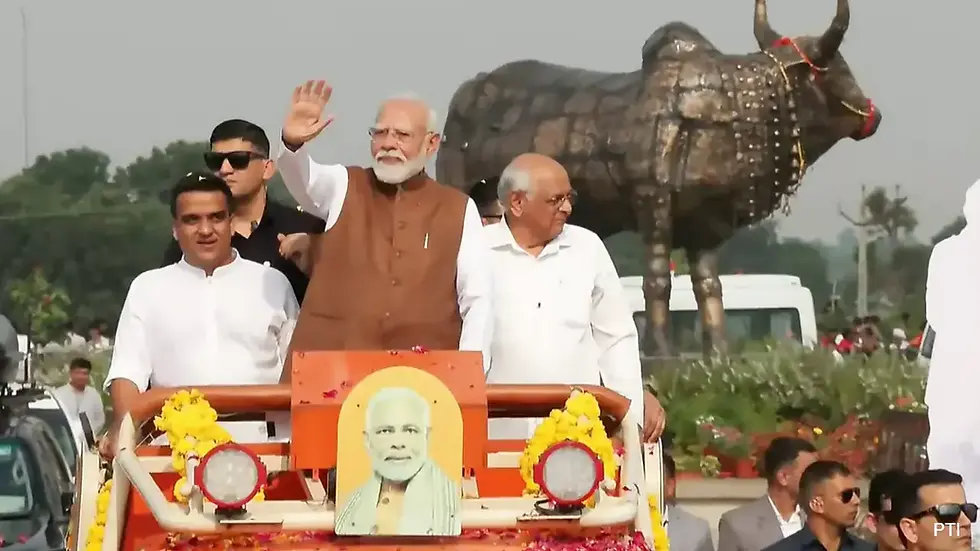
During his two-day visit to Gujarat on October 30 and 31, PM Modi inaugurated and laid the foundation stones for development projects worth more than ₹14,000 crore. The initiatives cover agriculture, dairy development, transportation, renewable energy, food processing and public welfare.
One of the major highlights was the Bharat Bovine Breeding and Research Centre at Bhildi in Banaskantha. Spread across 127 acres and developed at an investment of approximately ₹325 crore, the facility aims to strengthen indigenous cattle breeding through scientific research and advanced reproductive technologies.
The centre will focus on improving the genetic quality of indigenous cattle breeds, including Kankrej, Gir, Sahiwal and Tharparkar, as well as buffalo breeds such as Mehsani, Banni, Jaffarabadi and Murrah. It will use technologies such as in-vitro fertilisation (IVF) and embryo transfer to support improved breeding practices and higher milk productivity. The facility is expected to strengthen India's livestock sector by providing better breeding resources, supporting dairy farmers and preserving important indigenous cattle breeds.
Banas Dairy Expands Food Processing and Renewable Energy Initiatives
Several projects associated with Banas Dairy were also included in the development programme. These initiatives aim to connect agricultural production with food processing, modern storage facilities and renewable energy.
The expansion of the potato processing plant at Sanadar is expected to strengthen the processing of agricultural produce, including potato-based products. An automated storage and retrieval facility for ultra-high-temperature dairy products at Palanpur will improve storage management and distribution efficiency.
Another important initiative involves two Bio-CNG plants at Tharad and Radhanpur. The proposed facilities will process 75 metric tonnes and 100 metric tonnes of cattle dung per day, respectively. By converting cattle waste into Bio-CNG and organic fertiliser, these projects can support cleaner energy production, improve waste management and create additional economic opportunities for dairy farmers. These initiatives demonstrate how the dairy and agricultural sectors can contribute not only to food production but also to renewable energy and rural economic development.
Major Infrastructure Push Through Metro and Highway Expansion
Gujarat's transportation infrastructure also received significant attention during the visit. PM Modi laid the foundation stones for the Ahmedabad Metro Phase 2A Airport Extension and Phase 2B GIFT City Extension. These extensions are expected to improve connectivity between important commercial, administrative and transportation centres.
The Airport Extension will cover more than six kilometres with five stations, while the GIFT City Extension will extend over approximately 3.3 kilometres with three stations. Improved metro connectivity is expected to make public transportation more accessible and support the movement of commuters.
Another major project is the expansion of Ahmedabad-Mehsana Road, also known as State Highway-41. With an estimated investment of ₹2,600 crore, the existing four-lane road will be widened into an eight-lane highway. The project is expected to improve connectivity between Ahmedabad and North Gujarat, facilitate commercial transportation and support regional economic activity.
Strengthening Rural Development and Agricultural Infrastructure
Several initiatives were also announced to improve rural infrastructure and public welfare. Under the Anganwadi development programme, 361 completed child-friendly Anganwadi centres were inaugurated, while the foundation stones were laid for another 4,030 centres. The initiative involves an investment of approximately ₹800 crore and is expected to benefit more than four lakh people.
These centres are intended to strengthen early childhood care, nutrition and community-level services, particularly in rural areas. The Prime Minister also dedicated 521 projects completed under the Agriculture Infrastructure Fund, involving a combined investment of approximately ₹4,950 crore. The projects include warehouses, cold storage facilities, silos, greenhouses, polyhouses and food-processing units.
Such infrastructure plays an important role in reducing post-harvest losses, improving storage capacity and helping farmers preserve their produce for better market opportunities. Stronger agricultural infrastructure can also encourage investment in food processing and strengthen rural supply chains.
₹19,000 Crore PM-KISAN Instalment Released
Farmer welfare remained an important part of the Prime Minister's Gujarat visit. PM Modi released approximately ₹19,000 crore as the 24th instalment of the PM-KISAN Samman Nidhi scheme, providing financial assistance to eligible farmer families through direct bank transfers. The scheme aims to provide additional financial support to agricultural households and help them meet farming-related and other essential expenses.
The Prime Minister also marked the commencement of on-ground activities under 12 approved horticulture clusters covering approximately 1.46 lakh hectares. These clusters are expected to benefit more than 1.3 lakh farmers, with two clusters in North Gujarat focusing on potato cultivation. The initiative is intended to strengthen specialised agricultural production, improve infrastructure and create better opportunities for farmers through improved market connections.
New Railway Services to Improve Connectivity
Railway connectivity was another important component of the development programme. PM Modi flagged off the Ahmedabad (Sabarmati)-Varanasi Express and Mehsana-Becharaji-Sabarmati MEMU train services.
The new services are expected to provide additional travel options for passengers and improve connectivity across important destinations. Along with metro expansion and highway development, these railway initiatives form part of a broader effort to strengthen Gujarat's transportation network.
The MGMM Outlook
Prime Minister Narendra Modi’s Gujarat visit highlighted the government’s focus on maintaining economic stability amid international uncertainties while strengthening domestic development. Addressing concerns surrounding the Iran war, he cautioned against misinformation about fertiliser and LPG availability and emphasised the importance of protecting farmers and ordinary households from global disruptions. He also highlighted the government’s support for farmers through MSP payments and PM-KISAN assistance, including the release of approximately ₹19,000 crore under the scheme. His remarks reinforced the importance of reliable information, agricultural security and strengthening India's ability to manage international challenges.
Alongside this, development projects worth more than ₹14,000 crore across Gujarat highlighted progress in agriculture, dairy research, renewable energy, transportation and rural infrastructure. Initiatives such as the Bharat Bovine Breeding and Research Centre, Bio-CNG plants, metro and highway expansions, modern agricultural storage facilities and Anganwadi development are aimed at creating long-term economic opportunities. These investments reflect the importance of combining farmer welfare, scientific innovation and infrastructure development to strengthen rural livelihoods, improve connectivity and support India's broader growth ambitions.
(Sources: India Today, News18, Hindustan Times)


Comments