
PM Modi Launches ‘Nasha Mukt Yuva for Viksit Bharat Sankalp Abhiyan’: A Nationwide Push Towards a Drug-Free India

Prime Minister Narendra Modi has launched the ‘Nasha Mukt Yuva for Viksit Bharat Sankalp Abhiyan’, a nationwide campaign aimed at creating a drug-free India by mobilising the country's youth and encouraging community participation. The initiative is envisioned as a 100-week public movement that seeks to spread awareness about the dangers of substance abuse while promoting healthy lifestyles among young Indians. The campaign forms part of the broader vision of Viksit Bharat 2047, which aims to transform India into a developed nation by the centenary of its independence.
The campaign was launched through video conferencing, connecting more than one crore young participants from over 28,000 locations across the country. Educational institutions, youth organisations, civil society groups, government departments, and volunteers have joined the initiative, making it one of the largest anti-drug awareness movements undertaken in India.
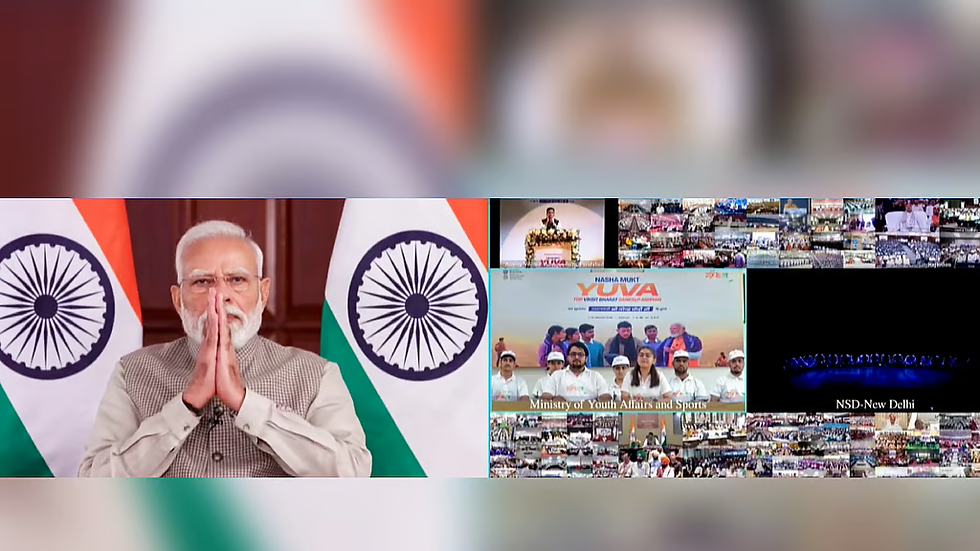
Youth at the Centre of India's Development Journey
During the launch, Prime Minister Modi stressed that the strength of a developed India lies in the health, discipline, and determination of its young population. He said that India's demographic advantage can become its greatest asset only if its youth remain free from addiction and are able to realise their full potential in education, innovation, entrepreneurship, sports, and public service.
The Prime Minister described today's young generation as the driving force behind India's future and emphasised that protecting them from substance abuse is essential for the country's long-term progress. According to him, a healthy and empowered youth population will play a decisive role in achieving the goal of making India a developed nation by 2047.
A 100-Week Jan Bhagidari Movement
Unlike conventional awareness campaigns that are limited to a few days, the Nasha Mukt Yuva for Viksit Bharat Sankalp Abhiyan has been designed as a sustained 100-week Jan Bhagidari movement. Every Sunday, programmes will be organised across the country to engage citizens in discussions, awareness drives, sports activities, yoga sessions, cultural performances, marathons, debates, seminars, and community outreach initiatives.
The campaign seeks to ensure that awareness against drug abuse remains an ongoing public effort rather than a one-time event. By encouraging participation from schools, colleges, universities, resident welfare associations, religious organisations, NGOs, and local communities, the government aims to create a nationwide social movement against addiction.
Building on the Success of the Varanasi Initiative
The nationwide campaign draws inspiration from a pilot programme conducted in Varanasi, where community participation and public awareness activities reportedly yielded encouraging results. Based on the response received in the city, the initiative has now been expanded across India with the objective of reaching every district and every section of society.
Officials believe that involving local communities directly will help spread awareness more effectively while encouraging individuals struggling with addiction to seek timely support and rehabilitation.
The Growing Challenge of Drug Abuse in India
Drug abuse has emerged as a significant social and public health concern in India over the past decade. According to the Ministry of Social Justice and Empowerment, substance abuse affects not only individuals but also families, educational outcomes, employment opportunities, and community well-being. Addiction often contributes to financial distress, mental health challenges, domestic conflict, and increased crime in affected communities.
Recognising these challenges, the government has increasingly focused on prevention, awareness, counselling, rehabilitation, and stronger enforcement against drug trafficking. The new campaign seeks to complement these efforts by encouraging citizens themselves to become active participants in preventing substance abuse.
Parents, Teachers and Society Have an Important Role
A key message delivered during the launch was that addressing drug addiction requires the collective involvement of families, educational institutions, and society. Prime Minister Modi urged parents not to ignore or conceal cases of addiction due to social stigma but instead seek timely counselling, medical treatment, and rehabilitation support.
Teachers and educational institutions were also encouraged to regularly engage students in conversations about the harmful effects of drugs. By creating an environment where young people feel comfortable discussing their concerns, families and educators can play a crucial role in preventing addiction before it becomes a serious problem.
Government Strengthens Efforts Against Drug Trafficking
Alongside awareness and rehabilitation initiatives, the Government of India has continued to strengthen enforcement against narcotics trafficking. Various law enforcement agencies, including the Narcotics Control Bureau (NCB), have intensified operations against drug smuggling networks, resulting in significant seizures of narcotics and the dismantling of organised trafficking syndicates.
The government has also expanded coordination between central agencies, state police forces, customs authorities, and international partners to curb the illegal movement of narcotics. These enforcement measures are intended to reduce the supply of illegal drugs while complementing demand-reduction programmes focused on awareness and rehabilitation.
Integration with Existing Anti-Drug Initiatives
The newly launched campaign builds upon the Nasha Mukt Bharat Abhiyaan, which was introduced in 2020 to spread awareness about substance abuse and strengthen rehabilitation services across the country. Since its launch, the programme has conducted awareness activities in thousands of educational institutions and communities while encouraging greater public participation in the fight against drugs.
The latest initiative also leverages the MY Bharat (Mera Yuva Bharat) platform to mobilise youth volunteers and encourage greater civic engagement. Through this network, young people will participate in awareness campaigns, community outreach programmes, volunteer activities, and local initiatives aimed at promoting a drug-free society.
A Vision Beyond Awareness
The campaign goes beyond traditional awareness drives by promoting long-term behavioural change through continuous community engagement. Health experts have often emphasised that preventing addiction requires a combination of education, emotional support, recreational opportunities, counselling, and accessible rehabilitation services. The government's approach seeks to combine these elements with active public participation to create a broader social movement.
Officials hope that sustained engagement over the next 100 weeks will encourage more individuals to seek help, reduce the stigma surrounding addiction, and inspire communities to actively support rehabilitation and prevention efforts.
The MGMM Outlook
The launch of the 'Nasha Mukt Yuva for Viksit Bharat Sankalp Abhiyan' reflects a determined effort to address one of India's growing social challenges through sustained public participation rather than short-term awareness campaigns. By placing youth at the centre of the initiative and extending the movement over 100 weeks, the government aims to build a culture of responsibility, healthy living, and civic engagement. The integration of educational institutions, families, volunteers, and community organisations demonstrates that combating substance abuse requires collective action alongside strong law enforcement and rehabilitation measures.
The campaign also aligns with the broader vision of Viksit Bharat 2047, recognising that India's demographic dividend can become its greatest strength only when young people are healthy, skilled, and free from addiction. By combining awareness, counselling, community outreach, and stronger anti-drug enforcement, the initiative seeks to create lasting behavioural change while reducing the social stigma associated with seeking help. If implemented consistently with active public participation, this nationwide movement has the potential to strengthen both individual well-being and the country's long-term developmental aspirations.
(Sources: OpIndia, The New Indian Express, Hindustan Times)


Comments