
India and South Korea Forge a Futuristic Partnership: A New Era of Strategic and Economic Collaboration
- MGMMTeam

- Apr 23
- 4 min read
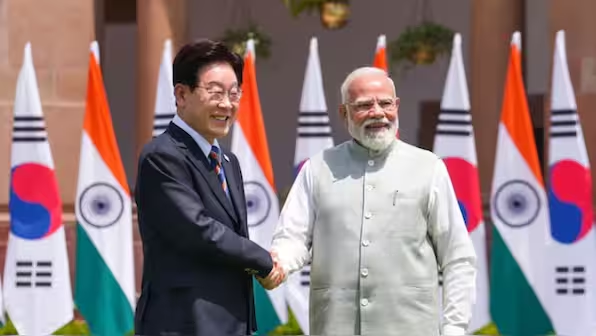
Prime Minister Narendra Modi and South Korean President Lee Jae-myung have ushered in a transformative phase in bilateral relations by announcing a comprehensive set of outcomes during the South Korean President’s state visit to India from April 19 to 21, 2026. The two leaders elevated the existing Special Strategic Partnership to a vibrant “futuristic partnership,” underpinned by an ambitious five-year roadmap covering 2026 to 2030. This development reflects the growing convergence of interests between the two democracies in an era of rapid technological advancement and global uncertainty.
The landmark announcements, made after detailed delegation-level talks at Hyderabad House, outline 25 key outcomes that span strategic cooperation, economic integration, technological innovation, sustainability, and cultural exchanges. Both sides have expressed strong commitment to translating this vision into tangible results that benefit their economies and contribute to regional stability.
Historical Foundations and Contemporary Relevance
The relationship between India and South Korea draws strength from deep civilisational ties that date back over two millennia. Ancient connections, symbolised by the legendary journey of Princess Suriratna (Heo Hwang-ok) from Ayodhya to the Korean kingdom in the first century AD, continue to inspire modern bonds. Formal diplomatic relations were established in 1973, evolving into a Strategic Partnership in 2010 and a Special Strategic Partnership in 2015.
President Lee’s visit, the first by a South Korean head of state in eight years, builds on this foundation at a time when both nations seek resilient supply chains, technological leadership, and diversified partnerships. Bilateral trade, which stands at around $27 billion, has grown steadily, with South Korea emerging as a significant investor in India. The current momentum aims to accelerate this growth and unlock new frontiers of cooperation.
Joint Strategic Vision and Institutional Mechanisms
Central to the outcomes is the adoption of a Joint Strategic Vision for the India-ROK Special Strategic Partnership (2026–2030). This guiding document envisions regular high-level engagements, including annual leader-level meetings, and the establishment of new platforms such as the India-ROK Industrial Cooperation Committee. It emphasises collaboration in critical areas like semiconductors, shipbuilding, defence, and supply chain resilience for strategic minerals.
Complementing this vision are major frameworks on shipbuilding, shipping and maritime logistics, sustainability, and energy resource security. These agreements lay the groundwork for deeper industrial integration and long-term strategic alignment between the two nations.
Economic Ambitions and Sectoral Cooperation
A defining feature of the partnership is the ambitious target to nearly double bilateral trade from approximately $27 billion to $50 billion by 2030. Leaders have outlined concrete steps to achieve this goal, including the resumption and fast-tracking of negotiations to upgrade the Comprehensive Economic Partnership Agreement (CEPA), the establishment of an India-Korea Financial Forum, and plans for a Korean Industrial Township in India.
Key sectors receiving focused attention include shipbuilding and maritime logistics, steel supply chains, artificial intelligence, semiconductors, advanced manufacturing, green energy, and critical minerals. Several Memorandums of Understanding (MoUs) have been signed to facilitate cooperation in ports, small and medium enterprises, science and technology, digital payments, and financial services. The newly launched India-Korea Digital Bridge is expected to drive collaboration in AI, data governance, and digital innovation.
Shared Commitment to Sustainability and Global Issues
Both countries have demonstrated a strong resolve to address pressing global challenges through joint initiatives. They have issued statements on sustainability and energy resource security, focusing on climate action, renewable energy, marine ecosystems, and stable supply of critical raw materials. South Korea has joined India-led platforms such as the International Solar Alliance and the Indo-Pacific Oceans Initiative, while India will participate in the Global Green Growth Institute.
The leaders also emphasised the importance of a free, open, and inclusive Indo-Pacific, multilateral reforms, and peaceful resolution of conflicts, sending a joint message of peace and stability amid global uncertainties.
Strengthening People-to-People and Cultural Ties
Recognising the power of soft power, the two sides have announced measures to deepen cultural and people-to-people connections. A new Cultural Exchange Programme for 2026–2030 has been launched, alongside the declaration of 2028–29 as the Year of India-ROK Friendship. Initiatives include a Distinguished Visitors Programme, expanded cooperation in creative industries, sports, education, and tourism.
With the rising popularity of Korean culture in India and Indian cinema in South Korea, these efforts are poised to bring the two societies closer together and foster greater mutual understanding.
The MGMM Outlook
The elevation of India–South Korea ties into a “futuristic partnership” reflects a clear shift toward pragmatic, forward-looking cooperation rooted in both strategic necessity and economic ambition. The structured roadmap for 2026–2030, combined with concrete institutional mechanisms, signals that this is not merely symbolic diplomacy but a calculated effort to align strengths in critical sectors like semiconductors, artificial intelligence, shipbuilding, and resilient supply chains. At a time of global uncertainty and shifting geopolitical balances, such a partnership strengthens India’s position as a reliable manufacturing and technology hub while offering South Korea diversification beyond traditional markets.
At the same time, the emphasis on sustainability, digital innovation, and cultural exchange shows that the relationship is being shaped beyond just trade numbers. Expanding people-to-people ties, integrating digital ecosystems, and collaborating on climate and energy goals create a more holistic engagement that can sustain long-term growth. The intent to nearly double bilateral trade and deepen industrial cooperation indicates that both nations are moving toward a mutually reinforcing economic model, where strategic alignment and shared democratic values translate into tangible development and regional stability.
(Sources: DD News, Firstpost, New Indian Express)


Comments