
Vande Mataram at 150: Modi Reignites a Historic National Debate

As India marked 150 years of Vande Mataram, the Lok Sabha’s commemorative session evolved into a powerful political and cultural moment. Prime Minister Narendra Modi used the occasion to revisit the historic decision made in 1937 to limit the national song to only two stanzas—a decision he described as a “grave injustice” influenced by the political pressures of that era. What was meant to be a celebration of a cultural milestone soon transformed into a debate over national identity, historical choices, and the enduring symbolism of Vande Mataram.
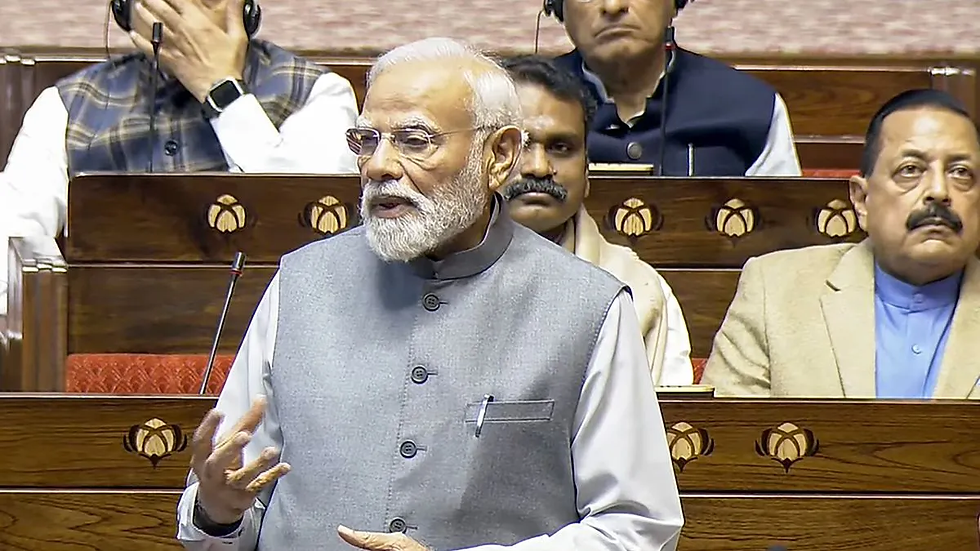
PM Modi’s Charge: A Question of Historical Integrity
In his speech, PM Modi described Vande Mataram as far more than a patriotic composition. For him, it is a civilisational symbol whose emotional and spiritual force shaped the imagination of countless freedom fighters. Modiji argued that the decision to truncate the song stemmed from an attempt to avoid displeasing certain political groups of the time, which he believes contributed to a mindset that weakened India’s cultural confidence.
The Prime Minister urged that the full glory of Bankim Chandra Chattopadhyay’s original composition be reclaimed. He framed the restoration of the complete song as not merely a cultural demand but a historical correction—one that honours the sacrifices made during the freedom struggle.
The Song’s Journey: From Literature to Liberation
Vande Mataram was penned in the 1870s and published in the 1882 novel Anandamath, where the imagery of a motherland under siege resonated deeply with a colonised nation. By the early 20th century, its verses became inseparable from the Swadeshi Movement, inspiring protest marches, rallies, and acts of resistance against the British Empire.
Its later stanzas, however, drew upon imagery associated with Hindu goddesses, prompting apprehensions within certain communities. The political leadership of pre-independence India ultimately chose to formally adopt only the first two stanzas—a decision that shaped the version recognised as the national song after 1947.
Yet, this compromise has continued to spark debate for decades, resurfacing repeatedly as a question of historical memory and cultural identity.
Why the Debate Returned in 2025
The 150-year anniversary gave fresh energy to old arguments. Leaders aligned with the ruling government framed the 1937 decision as an instance of weakening national symbols to placate communal sensitivities. They called for the restoration of the original, unedited version as an assertion of cultural authenticity.
Opposition voices countered that the reinterpretation of historical events served political interests. They argued that the original decision aimed to protect national unity in a deeply sensitive political climate and warned against weaponising cultural symbols for modern-day political contests.
Religious groups added yet another dimension, with some reiterating that the song’s theological elements do not align with monotheistic beliefs. This highlighted the complexity of reconciling a shared national identity with India’s religious diversity.
The Wider Reaction: Defence, Criticism, and Reflection
The debate ignited responses across the political spectrum. The ruling party defended the call for restoring the full version, framing it as a rightful reclamation of India’s cultural heritage. Opposition leaders accused the government of selectively interpreting history and attempting to impose a uniform cultural narrative.
Observers and commentators pointed out that Vande Mataram occupies a uniquely emotional space—neither purely political nor purely cultural. It is a symbol that carries the weight of history, the passion of the independence movement, and the complexities of India’s pluralistic society.
The MGMM Outlook
The 150th anniversary of Vande Mataram reopened one of India’s oldest debates—how to reconcile historical decisions with the cultural depth of a song that once embodied the nation’s anti-colonial spirit. PM Modi’s remarks in the Lok Sabha brought renewed focus to the 1937 choice of limiting the national song to two stanzas, a compromise shaped by the sensitivities of that period. His call to restore the full composition placed emphasis on honouring Bankim Chandra Chattopadhyay’s original vision and recognising the emotional force that inspired generations of freedom fighters. This revival of interest highlights how cultural symbols continue to evolve, reflecting shifts in society’s understanding of heritage and identity.
At the same time, the renewed discussion reveals the complexity surrounding symbols that carry religious, political, and emotional dimensions. Debates resurfaced over whether the truncated version preserves national unity or whether revisiting the original strengthens cultural authenticity. Religious groups, political voices, and commentators all engaged with the issue, showing how Vande Mataram occupies a space where devotion, nationalism, and diversity intersect. The anniversary did more than commemorate a historic milestone—it reaffirmed the song’s ongoing influence on how India interprets its past and imagines its cultural future.
(Sources: India TV News, India Today, Times of India)


Comments