
Somnath Temple: A Millennium of Faith, Resilience, and India’s Civilisational Continuity

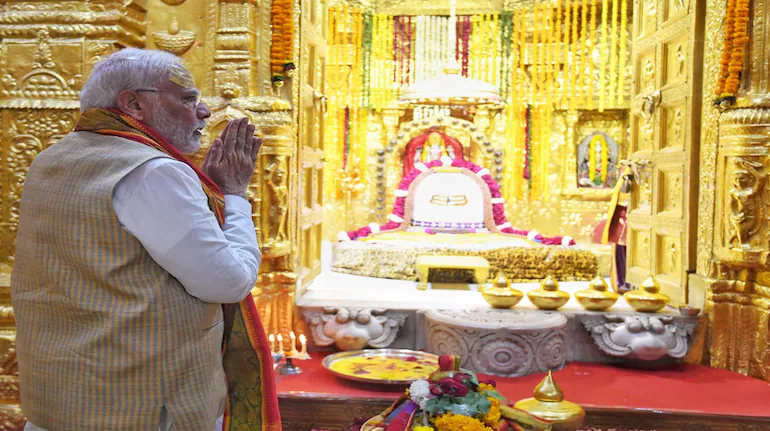
Standing on the shores of the Arabian Sea at Prabhas Patan in Gujarat, the Somnath Temple is one of India’s most sacred and historically significant places of worship. Revered as the first among the twelve Jyotirlingas of Lord Shiva, Somnath is deeply embedded in Hindu spiritual consciousness. More than a religious monument, the temple represents the enduring soul of Indian civilisation — one that has survived repeated attempts at erasure yet continues to inspire faith and cultural pride.
Ancient Roots and Sacred Significance
References to Somnath appear in ancient Hindu scriptures, including the Shiva Purana, underscoring its importance from early times. Archaeological evidence suggests continuous human settlement in the region since ancient periods, reinforcing the belief that Somnath has long been a centre of worship, learning, and cultural exchange. For devotees, a visit to Somnath is not merely a pilgrimage but a spiritual return to the origins of Sanatan tradition.
The First Assault and a Turning Point in History
The defining rupture in Somnath’s long history occurred in 1026 CE, when the temple was attacked and plundered by Mahmud of Ghazni. This marked the first recorded large-scale destruction of the shrine and began a prolonged era of repeated assaults. Yet, what followed was not the end of Somnath, but the beginning of its transformation into a symbol of resistance. Each attack was met with reconstruction, driven by the unwavering faith of devotees and local rulers who refused to let the shrine disappear from India’s sacred landscape.
Cycles of Destruction and Reconstruction
Over the centuries, Somnath faced multiple episodes of destruction during medieval invasions. Despite these repeated setbacks, the temple was rebuilt time and again, reflecting the unbroken civilisational will of the people. Even when political circumstances made restoration difficult, devotion to Somnath never faded. The shrine lived on in collective memory, poetry, oral traditions, and pilgrimage routes, ensuring that its spiritual presence endured even when its physical structure did not.
Post-Independence Revival and National Renewal
Following India’s independence, Somnath became a symbol of national resurgence. Sardar Vallabhbhai Patel envisioned the reconstruction of the temple as an assertion of India’s cultural self-confidence after centuries of colonial and external domination. Under his leadership, the Somnath Trust was formed to oversee the rebuilding process. In 1951, the newly reconstructed temple was consecrated by President Dr. Rajendra Prasad, who emphasized that Somnath’s revival represented India’s reclaiming of its historical and spiritual legacy. This moment marked not just the rebirth of a temple, but the reaffirmation of a civilisation.
A Thousand Years Since the First Attack
As India approaches 1,000 years since the first assault on Somnath, the temple has once again become the focus of national reflection. The milestone is being observed as a reminder that India’s history is not defined by defeat, but by endurance. Events commemorating this millennium highlight Somnath as a living testament to continuity — a place where faith has outlasted violence and devotion has outlived destruction.
Prime Minister Modi’s Reflection on Civilisational Strength
Prime Minister Narendra Modi, reflecting on Somnath’s journey, described the temple as an embodiment of India’s indomitable spirit. He emphasized that while invaders came and went, the cultural essence represented by Somnath remained intact. According to the Prime Minister, Somnath’s story is not about what was broken, but about what refused to break — the courage of countless Indians who preserved their civilisational identity across generations.
Somnath in Contemporary India
Today, Somnath stands not only as a sacred shrine but as a vibrant centre of pilgrimage and heritage tourism. Improved infrastructure and connectivity have made the temple more accessible, drawing millions of devotees each year. At the same time, Somnath continues to serve as a reminder of India’s plural historical experience — one marked by challenges, resilience, and renewal.
The MGMM Outlook
The Somnath Temple stands as one of the most powerful symbols of India’s civilisational continuity, faith, and cultural memory. As the first Jyotirlinga of Lord Shiva, its significance goes far beyond architecture or ritual; it represents an unbroken spiritual tradition rooted in Sanatan Dharma. Despite repeated attacks beginning with Mahmud of Ghazni’s invasion in 1026 CE and continuing through medieval times, Somnath never disappeared from India’s collective consciousness. Each destruction was followed by reconstruction, reflecting the determination of devotees and rulers who refused to let the shrine be erased. Even when the physical structure lay in ruins, Somnath survived through scripture, oral tradition, pilgrimage, and faith, underscoring that civilisations endure not merely through monuments but through belief and memory.
In independent India, Somnath’s reconstruction became an assertion of cultural self-respect and national renewal. Sardar Vallabhbhai Patel’s vision to rebuild the temple symbolised a reclaiming of historical identity after centuries of subjugation, while its consecration by President Dr. Rajendra Prasad reinforced the idea that cultural revival and modern nationhood could coexist. As the millennium since the first attack is commemorated, Somnath has emerged again as a focal point for reflection on India’s resilience. Prime Minister Narendra Modi’s remarks on the temple highlight a deeper truth: while invaders and regimes changed, the civilisational core represented by Somnath remained intact. Today, as a thriving centre of pilgrimage and heritage, the temple continues to affirm that faith, culture, and identity rooted in centuries cannot be broken by violence or time.
(Sources: The Times of India, Moneycontrol, The Financial Express)



Comments