
India–Qatar Relations Enter a New Phase of Strategic Depth

India and Qatar are witnessing a remarkable transformation in their bilateral relationship, marked by high-level diplomatic engagements, major economic agreements and a renewed vision for long-term cooperation. The recent interactions between Indian External Affairs Minister S. Jaishankar and Qatar’s top leadership, along with the landmark elevation of relations to a Strategic Partnership earlier this year, signify that New Delhi and Doha are looking beyond transactional exchanges and moving towards a structured, multi-sectoral alliance.
Strengthening Political Engagement
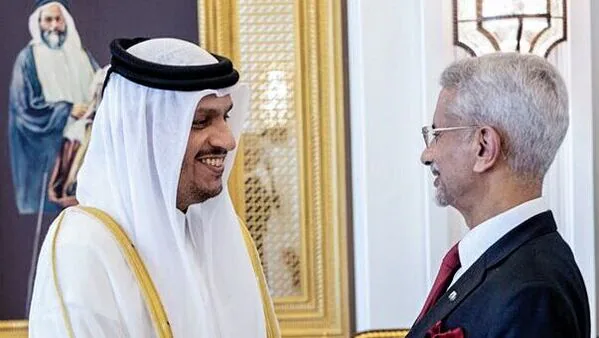
During his recent visit to Doha, S. Jaishankar held comprehensive discussions with Qatar’s Prime Minister and Foreign Minister, Sheikh Mohammed bin Abdulrahman Al-Thani. Their talks focused on enhancing cooperation in trade, energy, investment and regional affairs. He also met Qatar’s Amir, Sheikh Tamim bin Hamad Al-Thani, reaffirming India’s long-standing trust in Qatar’s leadership and its role in the geopolitics of West Asia. The interactions came at a time of heightened regional tensions, making India’s engagement with Qatar crucial for regional stability.
At the political level, this renewed closeness builds upon the February 2025 visit of the Qatari Amir to New Delhi, when both nations formally upgraded their ties to a Strategic Partnership. This marked a milestone in bilateral diplomacy and laid out a roadmap for expanded cooperation across economic, security, technological and cultural sectors.
A New Economic Vision and Expanding Trade
Economic collaboration stands at the core of India–Qatar relations. Both countries have set an ambitious target of doubling their trade volume from around USD 14 billion to USD 28 billion within the next five years. This commitment is supported by a revised Double Taxation Avoidance Agreement and a series of new MoUs covering fields such as economic cooperation, archives, youth affairs and investment promotion.
Qatar’s pledge of USD 10 billion in new investments into India underscores Doha’s growing confidence in the Indian economy. These funds are expected to flow into sectors including renewable energy, infrastructure, ports, technology, robotics and food processing. The establishment of a Joint Task Force on Investment and active engagement between leading business chambers of both countries further indicate a structured and long-term approach to strengthening economic ties.
Energy Security: The Backbone of the Partnership
Energy cooperation has traditionally been the strongest pillar of the India–Qatar relationship. Qatar remains one of India’s largest suppliers of liquefied natural gas (LNG) and liquefied petroleum gas (LPG). A major milestone was the signing of a 20-year LNG supply agreement between QatarEnergy and Petronet LNG, securing 7.5 million tonnes of LNG annually for India starting in 2028.
This deal not only ensures long-term energy security for India but also highlights Qatar’s reliability as a strategic energy partner. With India’s rapidly growing energy needs and its push towards cleaner fuels, Qatar’s role is set to become even more significant in shaping India’s energy landscape.
Strategic and Security Cooperation
Beyond economics, the two nations are expanding cooperation in areas fundamental to national security. Both countries have reiterated their condemnation of terrorism and have agreed to deepen cooperation in intelligence sharing, cyber security, anti-money laundering mechanisms and countering transnational crime. These mechanisms are expected to play a central role in maintaining stability in the Gulf region and South Asia.
The geopolitical significance of the partnership also extends to India’s outreach in West Asia, where Qatar plays a vital role as a mediator in regional conflicts and diplomatic negotiations. India’s recognition of Qatar’s diplomatic efforts, particularly in the context of the Gaza situation, reflects growing strategic trust.
People-to-People Connectivity and Cultural Exchange
The large Indian expatriate community in Qatar remains a major connecting bridge between the two countries. Efforts to promote business-to-business collaboration, virtual trade fairs and cultural exchanges have added new dimensions to this long-standing relationship. Multiple sectors including pharmaceuticals, electronics, food products, gems and jewellery and construction materials are being actively promoted through embassy-led initiatives.
Institutional support in the form of joint business councils and commercial working groups is expected to make bilateral trade more efficient and mutually beneficial. As Qatar diversifies its economy under the Qatar National Vision 2030, Indian businesses are well-positioned to become key partners.
The MGMM Outlook
India–Qatar relations are clearly entering a decisive and future-oriented phase, and from our viewpoint, this shift reflects India’s growing confidence on the world stage. The recent diplomatic outreach by External Affairs Minister S. Jaishankar shows that New Delhi is no longer approaching West Asia merely through transactional energy ties, but through a deeper, structured and strategic lens. The upgrade to a Strategic Partnership, the strengthening of political engagement with Qatar’s leadership and India’s recognition of Doha’s stabilizing role in a volatile region together signal a mature foreign policy approach. At the core of this transformation lies an ambitious economic agenda—doubling bilateral trade, modernizing taxation frameworks, and facilitating billions of dollars in new Qatari investments toward India’s technology, ports, clean energy and emerging innovation sectors.
From our perspective, this relationship is also becoming vital for India’s long-term security and global positioning. Energy cooperation—long the backbone of the partnership—has expanded into a significant 20-year LNG commitment, ensuring stability in India’s clean-fuel transition. The added layers of intelligence sharing, counter-terror coordination and cyber-security mechanisms show that India and Qatar are aligning on issues that extend far beyond economics. Meanwhile, India’s massive expatriate community and growing cultural and business exchanges ensure a strong people-driven foundation. Together, these shifts indicate that India and Qatar are not just strengthening ties—they are jointly shaping a modern, strategic alliance that serves mutual interests in an era of geopolitical uncertainty.
(Sources: Livemint, Hindustan Times, Business Standard)


Comments