
India and Brazil Move to Expand Mercosur Trade Pact, Opening New Avenues for Economic Cooperation

India and Brazil are moving ahead with plans to expand the existing preferential trade agreement between India and MERCOSUR, the South American regional trading bloc. The proposed expansion is aimed at widening market access, strengthening economic relations and creating additional opportunities for businesses on both sides.
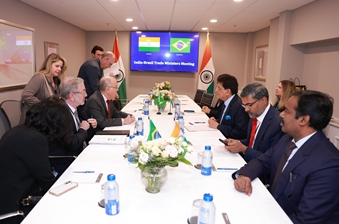
Brazil’s Minister of Development, Industry, Trade and Services, Márcio Elias Rosa, said the existing agreement covers only around 450 tariff lines and remains relatively limited. Speaking after his meeting with India’s Commerce and Industry Minister Piyush Goyal on the sidelines of the G20 Trade Ministers’ Meeting in Milwaukee, Rosa said India and Brazil had completed the Terms of Reference for broader negotiations. This framework is expected to guide the next stage of discussions on expanding the trade arrangement.
A Trade Agreement with Scope for Expansion
The India-MERCOSUR Preferential Trade Agreement was signed in 2004 and came into force in 2009. Under the current arrangement, India provides preferential tariff concessions on 450 tariff lines, while MERCOSUR provides concessions on 452 lines. Both sides have now agreed that the agreement can be expanded to cover a wider range of areas and provide greater opportunities for their private sectors.
The move follows growing economic engagement between India and the South American bloc. India-MERCOSUR trade reached $20.84 billion in 2025, according to the Ministry of Commerce and Industry. At the bilateral level, India-Brazil trade reached $15.07 billion in 2025–26, with both countries working towards increasing bilateral trade to $30 billion by 2030.
Focus on Pharmaceuticals, Agriculture and Industry
Pharmaceuticals are among the sectors receiving particular attention in India-Brazil economic discussions. A memorandum of understanding between India’s Central Drugs Standard Control Organisation and Brazil’s health regulator ANVISA, signed in February 2026, provides an institutional framework for closer cooperation in pharmaceuticals and healthcare.
Agriculture is another important area under discussion, with both countries working on phytosanitary issues and market-access requests. India and Brazil are also looking at opportunities involving chemicals, engineering products, machinery and other sectors where the two economies have complementary capabilities.
Digital Trade and Paperless Documentation
Alongside negotiations on expanding the agreement, India and MERCOSUR have taken steps to modernise trade procedures. In September 2026, the two sides signed the First Additional Protocol to facilitate electronic Certificates of Origin.
The protocol gives electronically issued Certificates of Origin the same legal validity as paper certificates, subject to the respective domestic procedures. The measure is intended to support paperless trade, reduce processing time and transaction costs, and make customs and preferential-trade procedures more efficient.
Cooperation Beyond Traditional Trade
The proposed expansion is also looking beyond conventional merchandise trade. According to the latest discussions, India and Brazil are exploring cooperation in areas including the bioeconomy, circular economy and digital economy, as well as artificial intelligence, skills development and defence. These areas could add new dimensions to the economic relationship as the negotiations progress.
The two countries had already agreed in 2025 that the expansion should address both tariff and non-tariff issues and seek to cover a significant share of bilateral trade. They also highlighted the importance of participation by the private sector and other stakeholders in the negotiation process.
Strengthening India's Engagement with South America
For India, a broader agreement with MERCOSUR could provide greater access to South American markets and create additional opportunities for exporters, manufacturers and businesses. For Brazil and other MERCOSUR members, deeper engagement with India provides access to one of the world's major consumer and production markets.
The development also comes as India continues to diversify its trade relationships and expand market-access arrangements with different regions. A broader India-MERCOSUR framework would strengthen economic links between India and Latin America while creating a larger platform for trade and investment.
The MGMM Outlook
The proposed expansion of the India-MERCOSUR trade agreement marks an important step in strengthening India’s economic engagement with Brazil and the wider South American region. With the existing pact covering a limited number of tariff lines, broader negotiations could open additional opportunities for Indian exporters and businesses across pharmaceuticals, agriculture, chemicals, engineering, machinery and other sectors. Rising trade between India and MERCOSUR, along with the goal of increasing India-Brazil bilateral trade to $30 billion by 2030, provides a strong foundation for deeper commercial cooperation.
The partnership is also moving beyond traditional merchandise trade, with discussions covering digital economy, artificial intelligence, bioeconomy, circular economy, skills and other emerging areas. The introduction of electronic Certificates of Origin further supports faster and more efficient trade procedures. A broader and more modern India-MERCOSUR framework can strengthen connectivity between Indian and South American markets while creating new avenues for trade, investment, technology and long-term economic cooperation.
(Sources: News On AIR, Mint)


Comments