
From Trade to Trust: India–US Partnership Enters a New Strategic Phase
- MGMMTeam

- Feb 10
- 4 min read
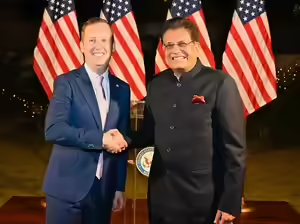
The evolving India–United States relationship was on full display at a high-profile reception in New Delhi hosted by US Ambassador to India, Sergio Gor. The event brought together senior Indian ministers, diplomats, and business leaders, serving as a public affirmation of the rapidly expanding partnership between the two democracies. The reception was not merely ceremonial, but came at a time when both countries are recalibrating their economic and strategic engagement amid shifting global power dynamics.
Ambassador Gor used the occasion to highlight that India–US ties are moving beyond traditional trade interactions toward a trust-based strategic partnership. Indian officials, including Commerce and Industry Minister Piyush Goyal, echoed this sentiment, emphasizing that the relationship is increasingly rooted in long-term cooperation across trade, technology, security, and regional stability.
Interim Trade Framework Marks a Reset
The reception followed the announcement of a major interim India–US trade framework that aims to resolve recent tariff disputes and lay the groundwork for a comprehensive Bilateral Trade Agreement expected to be finalized in the coming months. Under the interim arrangement, the United States has reduced reciprocal tariffs on select Indian exports to 18 percent, covering sectors such as textiles, apparel, leather, chemicals, plastics, and machinery.
Indian authorities have described the framework as a calibrated opening that balances export opportunities with protection of domestic sensitivities. Minister Goyal has stated that the deal is designed to strengthen bilateral ties while safeguarding key sectors, particularly agriculture. International reports indicate that the interim deal is intended as a bridge toward a broader agreement that will address non-tariff barriers, digital trade rules, and rules of origin, creating a more predictable trade environment for businesses on both sides.
Strategic Realignment and Energy Commitments
Beyond tariffs, the trade framework reflects a wider strategic realignment. As part of the evolving economic relationship, India has signaled its intent to significantly increase imports from the United States over the next five years, including in energy, aircraft, technology products, and critical industrial inputs. These commitments are closely linked to broader geopolitical considerations, including efforts by Washington to diversify energy partnerships and reduce India’s dependence on Russian crude.
Reuters and AP News have reported that the trade reset is also tied to US efforts to rebalance global supply chains and strengthen partnerships with trusted economies. For India, the agreement represents both an economic opportunity and a strategic positioning move, reinforcing its role as a key partner in Washington’s Indo-Pacific strategy.
Technology, Semiconductors, and Supply Chain Cooperation
Technology and advanced manufacturing have emerged as central pillars of the renewed partnership. Union Minister Ashwini Vaishnaw recently held discussions with Ambassador Gor focused on strengthening cooperation in semiconductors, electronics manufacturing, and supply chain resilience. These areas are seen as critical for reducing global vulnerabilities and supporting India’s ambition to become a major hub for high-tech production.
The United States has increasingly viewed India as a strategic partner in building resilient semiconductor and critical technology ecosystems. Joint efforts in artificial intelligence, digital infrastructure, and advanced manufacturing are expected to accelerate, supported by policy alignment and growing private-sector investment interest from both countries.
Strategic Trust and Indo-Pacific Alignment
Security and geopolitical alignment remain at the core of the relationship. Both governments have emphasized their shared commitment to stability in the Indo-Pacific, with cooperation spanning defense, counterterrorism, maritime security, and critical minerals. Ambassador Gor has repeatedly highlighted that high-level engagements between New Delhi and Washington are ongoing, reflecting a mutual desire to elevate the partnership beyond transactional diplomacy.
Prime Minister Narendra Modi and senior Indian officials have framed recent developments as evidence of growing international trust in India. The emphasis on trust signals a shift toward viewing the partnership as a long-term strategic alliance rather than a series of isolated trade negotiations.
The MGMM Outlook
The recent high-profile reception hosted by US Ambassador Sergio Gor in New Delhi highlighted the growing depth of India–US relations, reflecting a shift from a primarily trade-driven engagement to a broader, trust-based strategic partnership. Senior Indian leaders and US officials emphasized that cooperation is now expanding across trade, technology, security, and regional stability, signaling a more mature phase in bilateral ties. The interim trade framework, which reduces select US tariffs on Indian exports and sets the stage for a comprehensive Bilateral Trade Agreement, underscores a mutual effort to resolve disputes while creating a more predictable and balanced trade environment that also protects key domestic sectors.
Beyond trade, the partnership is increasingly shaped by strategic realignment in areas such as energy, advanced manufacturing, and supply chain resilience. India’s plans to boost imports from the US in energy, aircraft, and critical industrial inputs align with Washington’s push to diversify supply chains and strengthen ties with trusted partners. Cooperation in semiconductors, electronics, artificial intelligence, and digital infrastructure is emerging as a central pillar, alongside deeper security and Indo-Pacific coordination. Together, these developments point to a relationship that is becoming more comprehensive, combining economic engagement with long-term strategic and geopolitical alignment.
(Sources: News18, Economic Times, Business Standard)


Comments