
Chandrayaan-3 Honoured with Prestigious 2026 Goddard Astronautics Award

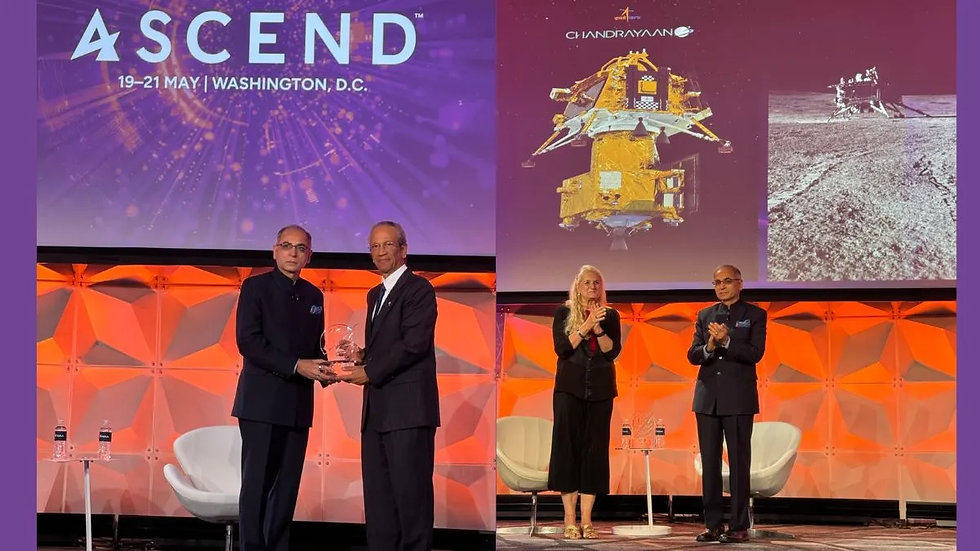
In a landmark moment for India's space programme, the Indian Space Research Organisation (ISRO) has been conferred the 2026 Goddard Astronautics Award by the American Institute of Aeronautics and Astronautics (AIAA). This prestigious honour recognises the remarkable success of the Chandrayaan-3 mission, particularly its historic soft landing near the Moon’s south pole.
The award was presented on May 21, 2026, during the AIAA ASCEND 2026 Conference in Washington, D.C. India’s Ambassador to the United States, Vinay Kwatra, received the accolade on behalf of ISRO. The official citation highlights “the groundbreaking landing of the ISRO’s Chandrayaan-3 near the lunar south pole region, to deepen our understanding of the moon and beyond.”
The Significance of the Goddard Astronautics Award
The Goddard Astronautics Award is one of the highest distinctions in the field of space exploration. Named after the pioneering American rocket scientist Robert H. Goddard, it celebrates extraordinary contributions that push the boundaries of astronautics through innovation, scientific excellence, and technical achievement. Past recipients include visionary leaders from NASA, industry giants like Jeff Bezos, and prominent researchers. By honouring ISRO, the award not only celebrates Chandrayaan-3’s technical triumph but also acknowledges India’s growing role as a formidable force in global space endeavours.
Mission Overview and Historic Achievements
Launched on July 14, 2023, aboard the LVM3-M4 rocket from the Satish Dhawan Space Centre in Sriharikota, Chandrayaan-3 served as a refined successor to the Chandrayaan-2 mission. The spacecraft comprised a Propulsion Module, the Vikram lander, and the Pragyan rover. After a precise journey, the Vikram lander achieved a flawless soft touchdown on August 23, 2023, at coordinates near 69.37°S, 32.35°E.
This accomplishment made India the first country to successfully land near the lunar south pole — a challenging region believed to hold significant reserves of water ice. It also positioned India as only the fourth nation, after the United States, the former Soviet Union, and China, to execute a controlled soft landing on the Moon. The mission’s scientific instruments delivered valuable in-situ data, including confirmation of sulfur in the lunar soil, detection of seismic activity through moonquakes, and detailed temperature profiles of the surface and subsurface. The Pragyan rover further analysed the elemental composition of the lunar terrain, advancing humanity’s knowledge of the Moon’s geology and potential resources.
Engineering Excellence and Remarkable Cost Efficiency
The success of Chandrayaan-3 stemmed from meticulous improvements in design, navigation, and landing systems, informed by lessons from previous missions. ISRO incorporated advanced hazard detection cameras, throttleable engines, and redundant safety mechanisms to ensure a precise and safe touchdown on the rugged lunar terrain.
What truly sets this mission apart is its exceptional cost efficiency. Executed at an approximate budget of ₹615 crore (around $75 million), Chandrayaan-3 demonstrated that groundbreaking space exploration is possible through resourceful innovation and indigenous technology. This frugal yet highly effective approach has drawn international admiration, showcasing India’s ability to achieve world-class results with modest financial investment.
Global Recognition and Broader Implications
The Goddard Astronautics Award elevates India’s stature in the international space community. It highlights the mission’s contribution not only to lunar science but also to the broader vision of sustainable space exploration. Data gathered by Chandrayaan-3 continues to support research into lunar resources, which could prove vital for future habitats, fuel production, and long-term human presence on the Moon.
This international acclaim reinforces ISRO’s reputation for reliability, ingenuity, and scientific excellence. It inspires a new generation of scientists and engineers while strengthening opportunities for global collaborations in space research.
The MGMM Outlook
Chandrayaan-3’s recognition with the 2026 Goddard Astronautics Award is more than an international honour—it is a strong affirmation of India’s growing leadership in global space exploration. The mission’s historic landing near the Moon’s south pole demonstrated not only ISRO’s technological capability but also the nation’s determination to pursue ambitious scientific goals with precision and confidence. This achievement has further strengthened India’s credibility as a reliable and innovative space power, capable of delivering groundbreaking results on the world stage.
What makes this accomplishment even more remarkable is the model of innovation it represents—high-impact science achieved through cost-effective, indigenous engineering. Chandrayaan-3 has become a symbol of how strategic vision, perseverance, and scientific excellence can transform national aspirations into global milestones. The award reflects international respect for India’s space programme and serves as an inspiration for future missions, encouraging the next generation to dream bigger as the country moves toward even more ambitious ventures in space exploration.
(Sources: India TV News, Economic Times, NDTV)


Comments