
Rafale’s Decisive Role in Operation Sindoor Reinforces IAF’s Drive for Major Fleet Modernisation

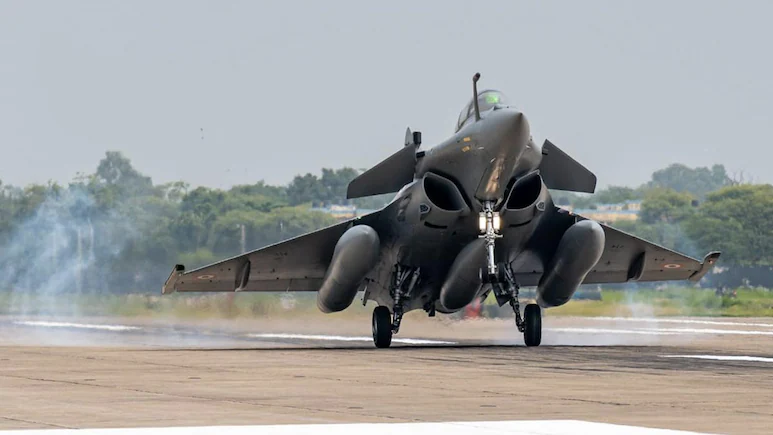
The Indian Air Force (IAF) has highlighted the Rafale fighter jet as a decisive platform during Operation Sindoor, underlining its growing importance in India’s air power doctrine. Vice Chief of the Air Staff Air Marshal Nagesh Kapoor described Rafale as a key operational asset, stating that the aircraft played a critical role in the success of the mission. His remarks, made ahead of Exercise Vayu Shakti 2026, reflect the IAF’s increasing reliance on advanced multi-role fighters to execute high-precision, time-sensitive operations.
Operation Sindoor was launched in May 2025 in response to the deadly terror attack in Pahalgam. The operation marked a calibrated yet forceful military response, with the IAF conducting precision strikes on multiple terror infrastructure targets across Pakistan and Pakistan-occupied Jammu and Kashmir. The mission demonstrated India’s capability to carry out swift and technologically sophisticated air operations while limiting exposure to hostile air defences.
Advanced Weapons and Electronic Warfare Shape the Outcome
According to official briefings, Rafale aircraft were equipped with advanced stand-off weapons, electronic warfare systems and air-defence suppression capabilities during the operation. The use of long-range SCALP cruise missiles and HAMMER precision-guided munitions enabled Indian aircraft to strike high-value targets with accuracy from safe distances. The Rafale’s sensor fusion and electronic countermeasures reportedly allowed the IAF to degrade enemy radar and missile systems, ensuring mission success within a compressed operational window.
Defence officials noted that the operation highlighted India’s growing proficiency in network-centric warfare. The ability to integrate intelligence, surveillance and reconnaissance assets with strike platforms allowed for rapid targeting, improved situational awareness and effective coordination across multiple domains. This reflected a shift in the IAF’s operational philosophy toward faster decision-making and precision-based deterrence.
Multi-Platform Integration Demonstrates Broader Air Power Strength
While Rafale emerged as the standout performer, Operation Sindoor also showcased the IAF’s broader combat ecosystem. Aircraft such as the Su-30MKI, Mirage 2000, MiG-29 and indigenous Tejas fighters supported the mission, demonstrating seamless multi-platform integration. Senior officials have stated that the operation validated years of investment in interoperability, data-linking and joint mission planning.
This coordinated approach underscored the IAF’s ability to conduct complex, layered operations involving air superiority, strike, electronic warfare and air defence roles simultaneously. The operation also reinforced the importance of maintaining a diverse and modern fleet capable of responding to varied threat scenarios across India’s extended strategic environment.
MRFA Program Gains Momentum Amid Squadron Shortages
In the aftermath of Operation Sindoor, the IAF has renewed its push to induct additional Multi-Role Fighter Aircraft under the long-pending MRFA program, which aims to procure up to 114 new-generation fighter jets. With several legacy aircraft nearing retirement, the IAF faces declining squadron strength, making fleet modernisation an urgent operational priority.
While no final selection has been announced, Rafale remains a strong contender, supported by its proven performance in operational conditions. The leadership has emphasised that new inductions are essential to maintain combat readiness and address the possibility of a two-front challenge, particularly in light of evolving regional security dynamics.
Exercise Vayu Shakti 2026 to Showcase Operational Capabilities
Exercise Vayu Shakti 2026, to be held in Pokhran, Rajasthan, is expected to publicly demonstrate many of the capabilities employed during Operation Sindoor. The large-scale air exercise will involve a wide range of IAF assets, including frontline fighters, transport aircraft, helicopters and air defence systems. Officials have indicated that the exercise will highlight long-range precision strikes, integrated air-ground coordination and rapid response scenarios.
The exercise is also expected to serve as a platform to demonstrate India’s growing technological edge in aerial warfare, reinforcing the IAF’s readiness to conduct complex missions under high-threat conditions.
Strategic Messaging and the Future of Indian Air Power
Air Marshal Kapoor has stressed that Operation Sindoor delivered a clear strategic message: acts of terrorism against India will be met with firm, precise and calibrated military responses. The operation not only showcased India’s strike capabilities but also reinforced its deterrence posture in a volatile regional environment.
The MGMM Outlook
Operation Sindoor has reinforced the Indian Air Force’s growing emphasis on precision, speed and technological dominance, with Rafale emerging as a central platform in executing high-impact air operations. The mission, launched in response to the Pahalgam terror attack, demonstrated India’s ability to conduct calibrated yet forceful strikes on terror infrastructure across Pakistan and Pakistan-occupied Jammu and Kashmir. Equipped with advanced stand-off weapons, electronic warfare systems and precision-guided munitions, Rafale enabled deep strikes while minimising exposure to hostile air defences. The operation reflected India’s increasing reliance on network-centric warfare, where intelligence, surveillance and strike platforms are tightly integrated to deliver rapid and accurate outcomes.
Beyond Rafale’s performance, Operation Sindoor highlighted the strength of the IAF’s broader combat ecosystem, with platforms such as Su-30MKI, Mirage 2000, MiG-29 and Tejas operating in a coordinated, multi-layered framework. This level of integration underlined the effectiveness of years of investment in interoperability and joint mission planning. The operation has also added urgency to the IAF’s fleet modernisation drive under the MRFA program, as squadron shortages and evolving regional threats demand faster induction of next-generation fighters. With Exercise Vayu Shakti 2026 set to showcase these operational capabilities, the focus remains firmly on strengthening India’s air power posture, precision strike readiness and long-term deterrence capacity.
(Sources: Firstpost, NDTV, Business Standard)


Comments