
India Strongly Rejects Pakistan’s Claims on Minority Rights, Calls Out Islamabad’s Own Record

India’s Ministry of External Affairs (MEA) has firmly rejected Pakistan’s recent remarks questioning the treatment of religious minorities in India, calling the allegations baseless and politically motivated. The response came after Pakistan’s Foreign Office spokesperson made statements urging the international community to take note of what Islamabad described as incidents targeting minorities in India.
Responding to these claims, MEA spokesperson Randhir Jaiswal said India outright rejects such comments, emphasising that they originate from a country whose own record on minority protection is deeply troubling. New Delhi made it clear that Pakistan’s repeated attempts to comment on India’s internal matters cannot distract from its own domestic realities.
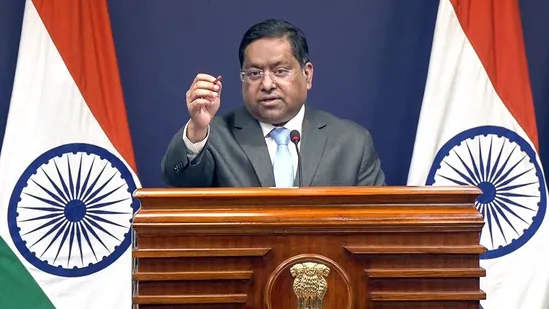
India Highlights Pakistan’s “Abysmal” Minority Record
In its rebuttal, the MEA stated that Pakistan has a well-documented history of systemic discrimination and persecution of minorities belonging to various faiths. Indian officials pointed out that issues such as forced conversions, misuse of blasphemy laws, targeted violence, and lack of legal protection for minorities continue to draw criticism from international human rights organisations.
India stressed that Pakistan lacks the moral authority to lecture other nations on minority rights while failing to safeguard its own vulnerable communities. The MEA added that no amount of “finger-pointing” can conceal these ground realities, which have been acknowledged globally over the years.
Pakistan’s Allegations and India’s Rejection
Pakistan’s comments referenced alleged incidents involving religious minorities in India, including claims of attacks on places of worship and communal violence. Islamabad also cited older controversial cases to support its narrative, suggesting a pattern of intolerance.
India categorically dismissed these allegations, asserting that Pakistan selectively raises such issues to deflect attention from its own governance failures and internal challenges. Indian officials reiterated that India is a pluralistic democracy governed by constitutional values, where issues are addressed through legal and institutional mechanisms.
A Pattern of Diplomatic Posturing
This exchange is part of a broader pattern of diplomatic sparring between the two countries. India has consistently objected to Pakistan’s attempts to internationalise internal Indian matters, describing them as interference driven by political motives rather than genuine concern.
At the same time, New Delhi has repeatedly raised concerns about minority rights in Pakistan at international forums, citing reports by global watchdogs. Observers note that such exchanges often intensify when Pakistan faces increased scrutiny over its internal human rights situation.
International Context and Regional Implications
Beyond Pakistan, India has also responded firmly to comments from other nations and international platforms on minority-related issues, asserting its sovereign right to address domestic matters without external interference. India has similarly voiced concern over attacks on minorities in neighbouring countries, reinforcing that minority protection remains a key aspect of its regional diplomatic engagement.
Experts believe these developments reflect a larger battle of narratives in South Asia, where human rights discourse is frequently used as a diplomatic tool amid strained bilateral relations.
The MGMM Outlook
India’s firm rejection of Pakistan’s claims on minority rights exposes the deep hypocrisy embedded in Islamabad’s narrative. Pakistan’s repeated attempts to lecture India on the treatment of religious minorities ring hollow given its own internationally documented record of persecution, forced conversions, misuse of blasphemy laws, and targeted violence against Hindus, Christians, Sikhs, Ahmadis, and Shias. Rather than addressing these systemic failures, Pakistan continues to weaponise selective incidents in India to divert global attention from its internal human rights crisis. Such allegations are not rooted in genuine concern but serve as a political smokescreen to mask governance failures and rising international scrutiny.
India’s response also highlights the stark contrast between the two nations’ constitutional frameworks and institutional accountability. As a pluralistic democracy, India addresses societal challenges through legal remedies, judicial oversight, and democratic processes, while Pakistan struggles with structural intolerance embedded in law and practice. Islamabad’s pattern of diplomatic posturing, including attempts to internationalise India’s internal matters, reflects a consistent strategy of deflection rather than reform. Global human rights organisations and independent reports have repeatedly flagged Pakistan’s treatment of minorities, reinforcing that moral authority cannot be claimed through rhetoric alone but must be earned through action and reform.
(Sources: Hindustan Times, Times of India, Firstpost)


Comments