
Bengaluru Start-up VoxelGrids Develops India’s First Indigenous MRI Scanner

In a significant milestone for India’s medical technology sector, VoxelGrids, a Bengaluru-based start-up, has developed the country’s first fully indigenous 1.5 Tesla Magnetic Resonance Imaging (MRI) scanner. The scanner has been installed at the Chandrapur Cancer Care Foundation near Nagpur, marking a crucial step toward self-reliance in advanced medical diagnostics.
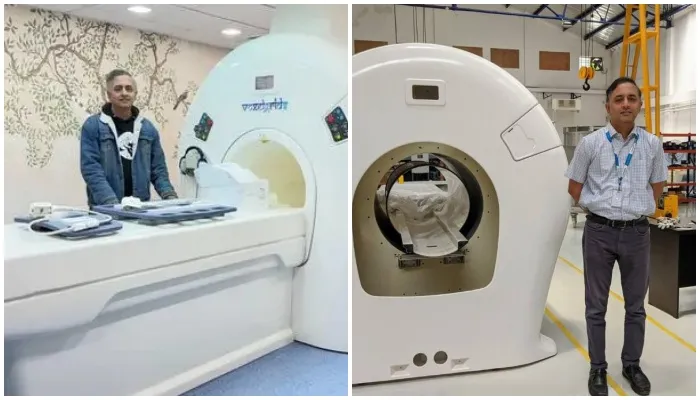
A Breakthrough in Medical Technology
For decades, India has depended on imported MRI machines from global companies like Siemens, GE Healthcare, and Philips. These machines are not only expensive but also require specialized infrastructure, limiting their availability to larger hospitals in urban centers. VoxelGrids’ achievement aims to bridge this gap by creating a cost-effective, locally manufactured alternative that is both affordable and accessible.
The MRI scanner incorporates a helium-free “dry magnet” design, eliminating reliance on scarce and expensive liquid helium. This innovation reduces production costs by roughly 40%, while also making the machine lighter, more energy-efficient, and easier to install in smaller hospitals or clinics.
Support from Government and Private Sector
VoxelGrids’ journey to this innovation was supported by the Government of India through the Biotechnology Industry Research Assistance Council (BIRAC) under the National Biopharma Mission, as well as by private partners like Zoho Corporation. The project exemplifies the government’s push for an Atmanirbhar Bharat (self-reliant India) in high-end medical technology.
The start-up’s founder, Dr. Arjun Arunachalam, led a 12-year-long research and development initiative to create a product that could not only match international standards but also cater to India’s unique healthcare challenges.
Features and Advantages of the Indigenous MRI Scanner
VoxelGrids’ MRI scanner weighs approximately 2–3 tonnes, compared to the typical 6 tonnes of conventional machines, making it suitable for hospitals with limited space. Its power-efficient design ensures stable operation even in regions with frequent electrical fluctuations. Additionally, VoxelGrids plans to implement a flexible pay-per-use model, allowing smaller hospitals to access high-end imaging without prohibitive upfront costs.
Implications for Healthcare in India
Currently, India has an estimated 5,000 MRI scanners, translating to roughly 3 units per million people, a figure far below that of developed nations. The indigenous scanner promises to democratize access to advanced imaging, especially in tier-2 and tier-3 cities, and could significantly enhance early diagnosis and treatment for cancer, neurological disorders, and other critical conditions.
The MGMM Outlook
Bengaluru-based start-up VoxelGrids has achieved a landmark in India’s medical technology sector by developing the country’s first fully indigenous 1.5 Tesla MRI scanner. Installed at the Chandrapur Cancer Care Foundation near Nagpur, this innovation addresses India’s longstanding dependence on imported MRI machines from global manufacturers, which are costly and limited to large urban hospitals. The scanner’s helium-free “dry magnet” design not only reduces production costs by around 40% but also makes it lighter, energy-efficient, and easier to install in smaller healthcare facilities, opening the door for wider accessibility across tier-2 and tier-3 cities. The initiative reflects over a decade of research led by Dr. Arjun Arunachalam and demonstrates the potential of combining cutting-edge technology with practical solutions for India’s unique healthcare challenges.
The project has received backing from both government and private entities, including the Biotechnology Industry Research Assistance Council (BIRAC) under the National Biopharma Mission and Zoho Corporation, highlighting India’s push toward self-reliance in advanced medical technology. Weighing just 2–3 tonnes compared to the conventional 6-tonne MRI machines, the scanner is also designed to function reliably in regions with frequent power fluctuations. With plans for a flexible pay-per-use model, VoxelGrids aims to make high-end imaging affordable for smaller hospitals, potentially improving early diagnosis and treatment of critical conditions like cancer and neurological disorders. This breakthrough sets a precedent for locally developed, high-quality medical devices, promising to reshape the accessibility and affordability of healthcare diagnostics in India.
(Sources: OpIndia, The Financial Express, Business Line)


Comments